|
Concluding Thoughts:
For what it is Worth...
First
off, if you have any questions in regard to planning your own
Hayduke Trail hike (sections, thru, whatever) please feel free
to contact me. I'd appreciate it if you have done some research on your own before asking me questions. Asking me where a "cool place to hike on the Hayduke" is, will not garner an enthusiastic response if any. The route is your's to plan. Take advantage of that freedom. Be certain to visit: www.hayduketrail.org as well. Great site, lots of info. Lastly, my thoughts are my
own and by no means 'right.'
Strategy:
Re-Supply, Water, Mileage, Gear, and Rest
As
I discussed in earlier postings, I tackled the Hayduke Trail in
typical long-distance hiker fashion: frequent re-supplies, higher
daily mileages, and with a focus towards lightweight equipment.
This presented some challenges and resulted in a longer
distance hiked than the described route, but I think this strategy
is critical to implement if you plan to tackle this rugged and
demanding route... especially so in the context of thru-hiking
the Hayduke.
Re-Supply:
Manageable for most...
I
would consider the re-supply on the Hayduke Trail convenient considering
the location of the route. Typically the distance between re-supply
is less than ~120 miles...manageable even at a casual pace (less
than 15 MPD) if your gear is light. I think the logistics of backcountry
caches for re-supply along the Hayduke are not worth the additional
time, money, or worry. Pack lighter, walk further. Being
a new route, re-supply stops along the Hayduke are not accustomed
to long distance hikers, so some explaining might need to take
place about your trip. Do not expect a trail register or hiker
exchange box at the PO . I found the majority of people very receptive
to the hike and very accommodating in the services they provided.
As the Old West dies and the New West takes shape, some towns
have embraced this change while others are not so receptive to
the idea. Be prepared.
Water:
Too Little or Too Much...
As
a number of people have pointed out about water in the desert:
you'll either die of thirst or drown. After spending 2 months
hiking in the desert, that seems accurate. Feast or famine. The
most H20 I carried was ~3 gallons and did so on 3 occasions. On
each anticipated dry stretch of 40+ miles, I was surprisingly
able to find water --- unmarked cattle tanks, seeps, or car campers.
Other times, I only carried 2 liters as there was ample opportunity
throughout the day to fill up. I'd say on average I had ~1.5 gallons
in the pack and only dry camped a handful of times. Generally
water availability dictates the framework for my schedule and
the miles per day that I hike. Spring water along the Hayduke
was surprisingly good. Keep in mind Utah had an above average
winter snow pack and a wet spring in '05. Without question some
sources that were running strong this year, may not be available
in leaner years to come. Of the long trails I've done,
I drank the most untreated water on the Hayduke --- 7 sources
total. Thus far, I've had no intestinal issues come up. Judge
the sources yourself.
MPD:
Miles Per Day...
For
me it was difficult to accurately plan a realistic MPD calculation
as I'd not done a long hike with as much XC terrain as the Hayduke
Trail presented. As such, I tended toward the conservative side
--- ~932 miles in 63 days with 6 planned rest days averaged out
to ~16.8 miles per day. In reality, the terrain was manageable
and I found I could cover 20+ miles. Therefore I was able to do
the hike in 60 days, including 8 rest days, and averaged 18 mpd.
Longest day was 27.
Gear:
The Lighter the Better...
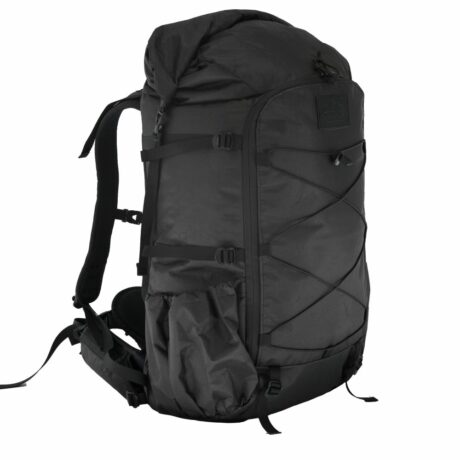
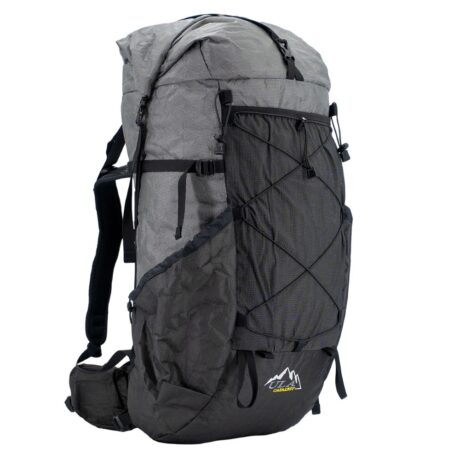
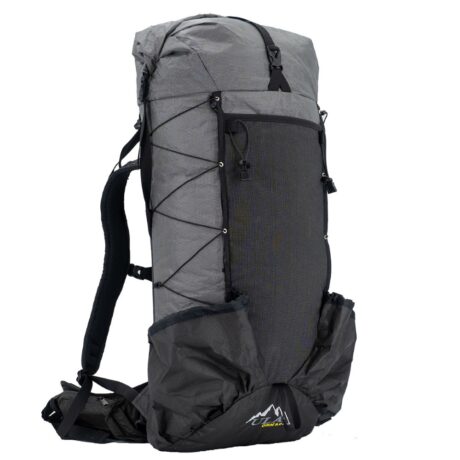
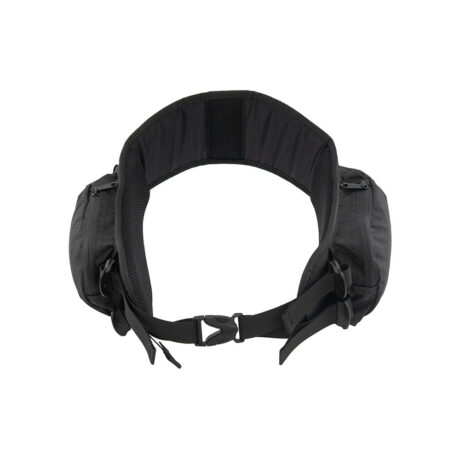
My
base weight for this hike (minus food, fuel, water) was ~12.5
lbs. In addition to the standards, I also carried ~40 ft of 1/2"
webbing, a bunch of 7.5' series maps, and a back-up water filter
which brought my base weight up a bit higher than normal. Regardless,
they were items necessary for the success of the trip, but just
not in my standard kit. Most of the route is pretty rugged walking,
and a lightweight gear set-up allowed me to maneuver more easily
and avoid basic stress and impact related injury. In addition,
when negotiating obstacles (pour-offs, cliff bands, pack hauls)
a lightweight pack is much less cumbersome to deal with.
Footwear:
I
chose a mid-top lightweight hiking boot (!) for footwear...a decision
I do not regret. Although they performed well, they were ready
for retirement after only ~375 miles of hiking --- the midsole
softened and the tread pretty much worn down. I sent myself a
new pair at mile ~475. The ankle support was much appreciated
negotiating steep slick rock, and crumbly side hills. During road
walks, I did not lace the uppers for better ankle mobility. Total
blister count: 4. If you decide on running shoes, I'd have no
less than 4 pairs at the ready and a good pair of tweezers to
pull the cactus spines out of your toes. Mesh panels will be destroyed
quickly and your socks will be filled with sand from day one.
In this case, I believe slightly heavier, non-mesh footwear is
the better choice.
Rest:
Obviously
this is dependent on how you are feeling mentally and physically,
but I took 8 rest days. Most of these I did not feel were necessary
for my mental or physical well-being, but rather as forced preventative
maintenance. As a result I avoided injury and maintained my health
for the duration of the trip.
Route:
Trail, Direction, Navigation, Weather, Guidebook
Trail:
The
basic corridor of the Hayduke Trail is exceptional. I think the
Founders of the route did a great job with its layout. While the
route appears quite circuitous on a map, and knowing that the
Colorado Plateau is an incredibly convoluted region, I had anticipated
a `choppy' and disconnected feel to the hike, but was surprised
at the routes sense of continuity while hiking. Many of
the areas you hike through I would consider `technical' walking...meaning
you need to be paying attention to your feet. When on actual trail
or dirt road the footing is (not surprisingly) quite good. However,
the XC portions are a jumble of loose rock, sand, spiny plants,
bushwhacks, mud, or some other such impediment to safe, `turn
off your brain' kind of hiking.
Direction:
Eastbound vs. Westbound
The
direction you chose to hike the Hayduke Trail should be related
to the season in which you decide to hike it. Although no consensus
exists, it seems accurate to state that if you start in the Spring,
you head West. If you start in the Fall, head East. The reasons
for this thinking should become obvious once you get into the
planning of your hike. I do not think one direction is
'easier' than the other. The route is rugged either way you look
at it. Physical and navigational challenges exist at both ends,
as do relatively high elevations that present challenges in regard
to weather and on-trail conditions.
Personally
I feel there are fewer variables to have to potentially
tackle in the Fall. While seeing snow is a very real possibility,
actual accumulation should be minimal. A strong monsoon is typical
for the region in late summer, which helps to re-charge water
sources, but can lead to flash flooding. Be aware. As I mentioned
beforehand as well, the range of temperature extremes is less
in the Fall and the weather is generally more stable.
The
Spring has a guarantee of some snow pack and associated runoff
--- not flash flooding, but potentially high water levels that
are quite cold. Obviously this provides ample water, but would
make foot travel very difficult due to mud, and water depth in
narrow canyons. Again, it will be obvious where when you get into
the planning. The Spring is also less stable in regard to the
weather. A greater range of temperature extremes makes for a wider
variety of necessary gear to be carried, as well as resulting
in windy conditions.
Navigation:
Where the &%#$ am I...?
I
did not find the navigation too difficult. In fact the compass
stayed in my pocket for the majority of the trip. A few times
it was helpful to orient the map or take a quick bearing, but
typically you are either in the bottom of a canyon, along a dirt
road, or in a well-signed National Park. However, note that I
was carrying 7.5 minute series maps. Plenty of detail. I did use
the maps from the Guidebook for some of the road walks. The tricky
spots are finding the correct entry/exit points into and out of
canyons and washes. GPS might be handy in knowing the exact waypoints
for these spots, but overall I think it would be dead weight.
Evaluate your navigation skills and plan accordingly.
Weather:
Rain, Snow, Floods, Wind
During my hike I was fortunate to have exceptional weather. I
did not set-up my tarp until ~400 miles into the trip. No rain
to speak of until the higher elevations of Bryce Canyon National
Park . All said, 6 nights of rain, and 1 day of pretty much continuous
rain and snow when crossing over the 11,000 ft Henry Mountains
. That one day of precipitation caused extensive regional flooding
and the canyons and rivers where I was (Dirty Devil) definitely
felt the impact (Oct 19 Journal entry). Water crossings demanded
attention, and walking through canyons was fatiguing in the mud
and slippery stones. Crossing the Colorado in the Grand Canyon
was no big deal. Plenty of friendly river folks to hitch a brief
ride with. Wind was thankfully never a real challenge,
despite a day or two of blustery conditions. Again, the less fluctuation
between high and low temperature extremes in the Fall helps to
keep the winds down.
Guidebook:
Future Authors Take Note...
I
think the Hayduke Trail Guidebook represents the future of long
distance hiking. Routes that are described in a general sense
--- providing basic details to facilitate additional planning.
In the spirit of the man whose name the trail bears, the route
itself is open to interpretation depending on how one wishes to
spend their time, and alternatives are easily accessed and plentiful
for a wide range of abilities. I think the guidebook is consistent
in this philosophy as it gives you enough detail to get you started
but by no means is enough info to answer all your questions or
guarantee success. As such I styled my own Hayduke hike to my
own preferences and did include alternative routes in the hike.
Although I followed the majority of the `official route' I feel
that my digressions made re-supply easier and enhanced my hike
overall. Much like the CDT used to be, each person will probably
hike a different Hayduke Trail than their predecessors, and that
is one of the beautiful aspects of a `route' vs. a `trail.' Basically
I used the Guidebook to plan the route at home, and then used
more in-depth sources and notes during the actual hike.
Recommended Reading : The 6 P's...
1)
Steve Allen: Canyoneering 2, Canyoneering 3
2)
Michael Kelsey: Assorted Text - Paria, Canyonlands , Colorado
Plateau
3)
Brett LeCompte: Southwest Circle Quest
Special Thanks:
Dustin
and Cecilie Ott at the Bryce
Canyon Inn
Gary
and Tracy at Canyonlands
Needles Outpost
Joe Mitchell, Hayduke Trail co-creator, and founder of www.Hayduketrail.org.
Mike
Coronella who was helpful with answering questions about the
Hayduke Trail pre-hike, and whose enthusiasm at its conclusion
for my hike was gracious and genuine. Thanks Mike!
Brett
Tucker, a fellow long distance hiker and founder of the Grand
Enchantment Trail was also helpful in doing some re-supply
recon for me in the Spring during a vacation around the Colorado
Plateua in the Spring. Many thanks Brett.
Tom Jones, canyoneer,
photographer, and
desert enthusiast was
a great help in curtailing some of my pre-hike anxieties. Thanks
Tom for the rendezvous' and the confidence.
Jerry
Goller for his outstanding shuttle services provided to and
from the trail back to my home in Logan, and good companionship
my first day on the Hayduke.
Last,
but certainly not least, many many thanks to my friend and co-conspirator
Brandt Hart. Without Brandt's help in overall planning the trip
would have certainly been less spectacular than it turned out
to be. His knowledge of the area, appreciation for the landscape
and its history, greatly enhanced my hike as did his company during
9 days of hiking with him in the Escalante. Brandt also provided
a steady supply of weather info, good humor, and re-supply surprises
along the way. Thank you my friend.
|